mysql -p -u username database_name < file.sql
Month: January 2015
MySQL server has gone away during Import
Server timed out and closed the connection. How to fix:
- check that wait_timeout variable in your mysqld’s my.cnf configuration file is large enough. On Debian:
sudo nano /etc/mysql/my.cnf, setwait_timeout = 600seconds (you can tweak/decrease this value when error 2006 is gone), thensudo /etc/init.d/mysql restart. I didn’t check, but the default value for wait_timeout might be around 28800 seconds (8 hours). - Server dropped an incorrect or too large packet. If mysqld gets a packet that is too large or incorrect, it assumes that something has gone wrong with the client and closes the connection. You can increase the maximal packet size limit by increasing the value of max_allowed_packet in my.cnf file. On Debian:
sudo nano /etc/mysql/my.cnf, setmax_allowed_packet = 64M(you can tweak/decrease this value when error 2006 is gone), thensudo /etc/init.d/mysql restart.
Trigger MySQL Mengurangi/Menambah Stok
Pertama-tama kita buat dulu database sederhana kita beri nama : Inventory, atau terserah apalah bagi yang belum bisa buat databasae coba simak altikel berikut.
Selanjutnya kita buat tabel-tabelnya yaitu barang, jual, dan beli
|
1
2
3
4
5
6
7
8
9
10
11
12
13
14
15
16
17
18
19
20
21
22
23
|
CREATE TABLE IF NOT EXISTS `barang` ( `kodebrg` varchar(15) NOT NULL, `nama` varchar(15) NOT NULL, `satauan` varchar(5) NOT NULL, `stok` int(11) NOT NULL, PRIMARY KEY (`kodebrg`)) ENGINE=InnoDB DEFAULT CHARSET=latin1;CREATE TABLE IF NOT EXISTS `beli` ( `nofaktur` varchar(15) NOT NULL, `tgl` date NOT NULL, `kodebrg` varchar(15) NOT NULL, `qty` int(11) NOT NULL, PRIMARY KEY (`nofaktur`)) ENGINE=InnoDB DEFAULT CHARSET=latin1;CREATE TABLE IF NOT EXISTS `jual` ( `nofaktur` varchar(15) NOT NULL, `tgl` date NOT NULL, `kodebrg` varchar(15) NOT NULL, `qty` int(11) NOT NULL, PRIMARY KEY (`nofaktur`)) ENGINE=InnoDB DEFAULT CHARSET=latin1; |
Perhatikan struktur tabel agar trigger bisa di eksekusi!! pakek analogi sederhana kita akan mengurangi stok dari tabel barang kita lock PK(Primary Key)-nya dalam kasus ini kodebrg ini kita jadikan senjata ditabel lain untuk memicu trigger nantinya, atau bahasa mudahnya tabel yang akan dipasang trigger harus memiliki field tabel yang akan di kenakan trigger.
Jika sudah jadi masukan beberapa data barang lewat menu Insert, saya coba seperti tampak pada gambar dibawah ini

Selanjutnya coba kita pasang Trigger di tabel jual, kita gunakan fasilitas yang sudah ada saja perhatikan gambar

Maka akan tampak tampilan jendela trigger seperti gambar dibawah :
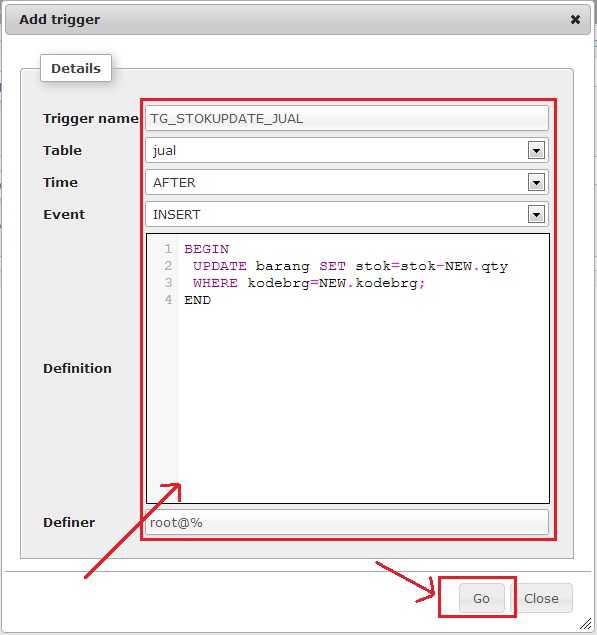
Penjelasanya :
– Trigger name : nama trigger (terserah isikan nama apa saja cuman buat mempermudah saat edit dsb).
– Table : dimana Trigger tersebut aktif
– Time serta Event : sudah dijelaskan diatas yaitu waktu dimana trigger dieksekusi
(jika diterjemahkan maka trigger dengan nama : TG_STOKUPDATE_JUAL akan aktif setelah tabel jual melakukan insert record)
– Definition : adalah isi trigger yang kita buat, penjelasan
|
1
2
3
4
5
6
7
|
BEGIN UPDATE barang SET stok=stok-NEW.qty //mengupdate tabel barang filed stok, dimana stok=stok (dikurangi) //NEW.qty maksutnya field qty dari record baru yang di insert ditabel jual WHERE kodebrg=NEW.kodebrg; //dimana kodebrg nya adalah field kodebrg dari record baru yang diinsert ditabel jualEND |
– Definer : yang menggunakan trigger, root@% (maksutnya user root di semua ip) bisa juga root@localhost, atau ip yg diperbolehkan saja root@192.168.1.1 misalnya.
Setelah itu lakukan cara yang sama tambahkan trigger pada tabel beli tidak perlu takut salah karena bisa diedit juga, karena logikanya jika kita beli maka nambah stok maka cukup sedikit dirubah pada tanda matematisnya menjadi :
UPDATE barang SET stok=stok+NEW.qty
Oke sekarang coba lakukan insert di tabel jual maupun beli lewat mysql saja, perhatikan baik2 stoknya jangan salah menuliskan kode barang karena klo salah trigger tidak jalan, lihat gambar :

Maksutnya kita akan menjual barang dengan kodebrg BR001 sejumlah 3, nah setelah di eksekusi coba buka tabel barang yang tadinya barang dengan kode BR001 (Rinso) stok: 10, sekarang berkurang menjadi 7. lakukan test juga pada tabel beli maka stok akan otomatis bertambah…
Selamat mencoba dan semoga menambah manfaat 🙂
Sumber artikel: https://mboloz.wordpress.com/2013/02/22/trigger-mysql-mengurangi-stok/
How to get the Date in a batch file in a predictable format?
This example works on cmd file format (.cmd):
@For /F "tokens=2,3,4 delims=/ " %%A in ('Date /t') do @(
    Set Month=%%A
    Set Day=%%B
    Set Year=%%C
)

@echo DAY = %Day%
@echo Month = %Month%
@echo Year = %Year%
PHP: Directory Listing
1. Single Directory Listing
To get started, here is a simple function that returns a list of files, directories and their properties from a single directory (more advanced versions of this function can be found further down the page):
<?PHP function getFileList($dir) { // array to hold return value $retval = array(); // add trailing slash if missing if(substr($dir, -1) != "/") $dir .= "/"; // open pointer to directory and read list of files $d = @dir($dir) or die("getFileList: Failed opening directory $dir for reading"); while(false !== ($entry = $d->read())) { // skip hidden files if($entry[0] == ".") continue; if(is_dir("$dir$entry")) { $retval[] = array( "name" => "$dir$entry/", "type" => filetype("$dir$entry"), "size" => 0, "lastmod" => filemtime("$dir$entry") ); } elseif(is_readable("$dir$entry")) { $retval[] = array( "name" => "$dir$entry", "type" => mime_content_type("$dir$entry"), "size" => filesize("$dir$entry"), "lastmod" => filemtime("$dir$entry") ); } } $d->close(); return $retval; } ?>
You can use this function as follows:
<?PHP // list files in the current directory $dirlist = getFileList("."); $dirlist = getFileList("./"); // a subdirectory of the current directory called images $dirlist = getFileList("images"); $dirlist = getFileList("images/"); $dirlist = getFileList("./images"); $dirlist = getFileList("./images/"); // using an absolute path $dirlist = getFileList("{$_SERVER['DOCUMENT_ROOT']}/images"); $dirlist = getFileList("{$_SERVER['DOCUMENT_ROOT']}/images/"); ?>
The variable $_SERVER['DOCUMENT_ROOT'] should resolve to the root directory of your website. e.g. /var/www/public_html
The return value is an associative array of files including the filepath, type, size and last modified date, except when a file is actually a directory, in that case the string “(dir)” appears instead of the filesize. The filenames take the same stem as the function call:
Example 1:
<?PHP $dirlist = getFileList("images"); echo "<pre>",print_r($dirlist),"</pre>"; /* sample output Array ( [0] => Array ( [name] => images/background0.jpg [type] => image/jpeg [size] => 86920 [lastmod] => 1077461701 ) [1] => ... ) */ ?>
Example 2:
<?PHP $dirlist = getFileList("./images"); echo "<pre>",print_r($dirlist),"</pre>"; /* sample output Array ( [0] => Array ( [name] => ./images/background0.jpg [type] => image/jpeg [size] => 86920 [lastmod] => 1077461701 ) [1] => ... ) */ ?>
If you want the output sorted by one or more fields, you should read the article on Sorting Arrays of Arrays or try out one of our DHTML Sorting Algorithms using JavaScript.
We also have an article on Directory Listing using SPL classes (DirectoryIterator and SplFileInfo) which introduces many new options for filtering and sorting the output.
2. Displaying File List in HTML
To output the results to an HTML page we just loop through the returned array:
<?PHP // output file list in HTML TABLE format echo "<table border=\"1\">\n"; echo "<thead>\n"; echo "<tr><th>Name</th><th>Type</th><th>Size</th><th>Last Modified</th></tr>\n"; echo "</thead>\n"; echo "<tbody>\n"; foreach($dirlist as $file) { echo "<tr>\n"; echo "<td>{$file['name']}</td>\n"; echo "<td>{$file['type']}</td>\n"; echo "<td>{$file['size']}</td>\n"; echo "<td>",date('r', $file['lastmod']),"</td>\n"; echo "</tr>\n"; } echo "</tbody>\n"; echo "</table>\n\n"; ?>
This code can be easily modified to: make the output a list instead of a table; make the file names actual links; replace the names with icons based on file type or extension; etc.
Display PNG images in a TABLE:
For example, to display only PNG files, just add a condition to the output loop:
<?PHP // output file list as HTML table echo "<table border=\"1\">\n"; echo "<thead>\n"; echo "<tr><th></th><th>Name</th><th>Type</th><th>Size</th><th>Last Modified</th></tr>\n"; echo "</thead>\n"; echo "<tbody>\n"; foreach($dirlist as $file) { if(!preg_match("/\.png$/", $file['name'])) continue; echo "<tr>\n"; echo "<td><img src=\"{$file['name']}\" width=\"64\"></td>\n"; echo "<td>{$file['name']}</td>\n"; echo "<td>{$file['type']}</td>\n"; echo "<td>{$file['size']}</td>\n"; echo "<td>",date('r', $file['lastmod']),"</td>\n"; echo "</tr>\n"; } echo "</tbody>\n"; echo "</table>\n\n"; ?>
Here you can view the complete source code for this example.
This will have the effect of skipping all files whose name does not end with .png. You could also apply conditions based on the file type, size, or last modified timestamp.
List PDF files with links:
One last example, listing only PDF files and having the file name link to the file:
<table border="1"> <thead> <tr><th>Name</th><th>Type</th><th>Size</th><th>Last Modified</th></tr> </thead> <tbody> <?PHP // output file list as table rows foreach($dirlist as $file) { if($file['type'] != 'application/pdf') continue; echo "<tr>\n"; echo "<td><a href=\"{$file['name']}\">",basename($file['name']),"</a></td>\n"; echo "<td>{$file['type']}</td>\n"; echo "<td>{$file['size']}</td>\n"; echo "<td>",date('r', $file['lastmod']),"</td>\n"; echo "</tr>\n"; } ?> </tbody> </table>
Here you can view the complete source code for this example.
If you want to display, for example, a thumbnail as a link to a larger image, or even a video, just give the two files the same name and in the script above use str_replace or similar function to modify either the link href or the link contents. See our article on listing images for examples.
Using the SPL DirectoryIterator and FilterIterator classes we can now specify a pattern to match when accessing the file list so only matching files are returned. More on that here.
3. Recursive Directory Listing
Now that we’ve got this far, it’s only a minor change to extend the function in order to recursively list any subdirectories. By adding a second parameter to the function we also retain the previous functionality of listing a single directory.
<?PHP // Original PHP code by Chirp Internet: www.chirp.com.au // Please acknowledge use of this code by including this header. function getFileList($dir, $recurse=false) { $retval = array(); // add trailing slash if missing if(substr($dir, -1) != "/") $dir .= "/"; // open pointer to directory and read list of files $d = @dir($dir) or die("getFileList: Failed opening directory $dir for reading"); while(false !== ($entry = $d->read())) { // skip hidden files if($entry[0] == ".") continue; if(is_dir("$dir$entry")) { $retval[] = array( "name" => "$dir$entry/", "type" => filetype("$dir$entry"), "size" => 0, "lastmod" => filemtime("$dir$entry") ); if($recurse && is_readable("$dir$entry/")) { $retval = array_merge($retval, getFileList("$dir$entry/", true)); } } elseif(is_readable("$dir$entry")) { $retval[] = array( "name" => "$dir$entry", "type" => mime_content_type("$dir$entry"), "size" => filesize("$dir$entry"), "lastmod" => filemtime("$dir$entry") ); } } $d->close(); return $retval; } ?>
To make use of the new functionality, you need to pass a value of true (or 1) as the second parameter.
<?PHP // single directory $dirlist = getFileList("./"); // include subdirectories $dirlist = getFileList("./", true); ?>
Before recursing the script first checks whether sub-directories are readable, and otherwise moves on to the next item so as to avoid permission errors.
As before, the return value is an array of associative arrays. In fact the only change is that you have the additional option of a recursive listing.
4. Limited Depth Recursion
This final example adds another feature – the ability to specify how deep you want the recursion to go. The previous code would continue to explore directories until it ran out of places to go. With this script you can tell it to not go deeper than a fixed number of levels in the file system.
<?PHP // Original PHP code by Chirp Internet: www.chirp.com.au // Please acknowledge use of this code by including this header. function getFileList($dir, $recurse=false, $depth=false) { $retval = array(); // add trailing slash if missing if(substr($dir, -1) != "/") $dir .= "/"; // open pointer to directory and read list of files $d = @dir($dir) or die("getFileList: Failed opening directory $dir for reading"); while(false !== ($entry = $d->read())) { // skip hidden files if($entry[0] == ".") continue; if(is_dir("$dir$entry")) { $retval[] = array( "name" => "$dir$entry/", "type" => filetype("$dir$entry"), "size" => 0, "lastmod" => filemtime("$dir$entry") ); if($recurse && is_readable("$dir$entry/")) { if($depth === false) { $retval = array_merge($retval, getFileList("$dir$entry/", true)); } elseif($depth > 0) { $retval = array_merge($retval, getFileList("$dir$entry/", true, $depth-1)); } } } elseif(is_readable("$dir$entry")) { $retval[] = array( "name" => "$dir$entry", "type" => mime_content_type("$dir$entry"), "size" => filesize("$dir$entry"), "lastmod" => filemtime("$dir$entry") ); } } $d->close(); return $retval; } ?>
As before we’ve added a single new parameter and a few lines of code. The default value of the depth parameter, if not defined in the function call, is set to false. This ensures that all previous features remain and that any legacy code won’t break when the function is changed.
In other words, we can now call the getFileList function with one, two or three parameters:
<?PHP // single directory $dirlist = getFileList("./"); // include all subdirectories recursively $dirlist = getFileList("./", true); // include just one or two levels of subdirectories $dirlist = getFileList("./", true, 1); $dirlist = getFileList("./", true, 2); ?>
This is a good example of how a function can evolve over time without becoming unmanageable. Too often you see functions that were once useful become unusable because of parameter bloat.
Go to next/previous record mysql
Here is an example:
<?php
$con = mysqli_connect(“localhost”,”root”,””,”vehicle”);
// Check connection
if (mysqli_connect_errno())
{
echo “Failed to connect to MySQL: ” . mysqli_connect_error();
}if (isset($_POST[‘id’])) {
$tmp = array_keys($_POST[‘id’]);
$curid = intval($tmp[0]);// Select contents from the selected id
$sql = “SELECT * FROM cars WHERE id={$curid}”;
$result = mysqli_query($con,$sql);
if (mysqli_num_rows($result)>0) {
$info = mysqli_fetch_assoc($result);
} else {
die(‘Not found’);
}// Next id
$sql = “SELECT id FROM cars WHERE id>{$curid} LIMIT 1”;
$result = mysqli_query($con,$sql);
if (mysqli_num_rows($result)>0) {
while($row = mysqli_fetch_assoc($result)) {
$nextid = $row[‘id’];
}
}// Prev id
$sql = “SELECT id FROM cars WHERE id<{$curid} LIMIT 1″;
$result = mysqli_query($con,$sql);
if (mysqli_num_rows($result)>0) {
while($row = mysqli_fetch_assoc($result)) {
$previd = $row[‘id’];
}
}
} else {
// No form has been submitted so use the lowest id and grab its info
$sql = ” SELECT * FROM cars WHERE id > 0 LIMIT 1″;
$result = mysqli_query($con,$sql);
if (mysqli_num_rows($result)>0) {
$info = mysqli_fetch_assoc($result);
}
}if (isset($info)) {
$content = ‘<pre>’.print_r($info,true).'</pre>’;
} else {
$content = ‘Nothing in the db :(‘;
}
?>
<html>
<head>
<title>Next prev</title>
</head>
<body>
<h3>Info</h3>
<?php echo $content; ?>
<form method=”post”>
<?php if (isset($previd)) { ?>
<input type=”submit” name=”id[<?php echo $previd?>]” value=”prev”>
<?php } ?>
<?php if (isset($nextid)) { ?>
<input type=”submit” name=”id[<?php echo $nextid?>]” value=”next”>
<?php } ?>
</form>
</body>
</html>
Source: http://board.phpbuilder.com/showthread.php?10352339-go-to-next-record-mysql
Change the input box height and font size Flexigrid Grocery-CRUD
Flexigrip CSS.
.flexigrid div.form-div input[type=text] {
font-size: 16px; // this part
………………..
height:35px; //change this too
…..
}
How to Convert Time to Minutes or Seconds
function HourMinuteToDecimal($hour_minute) {
        $t = explode(':', $hour_minute);
        return $t[0] * 60 + $t[1];
}

echo HourMinuteToDecimal("23:30");
function HourSecondsToDecimal($hour_minute) {
        $t = explode(':', $hour_minute);
        return $t[0] * 3600 + $t[1] * 60 + $t[2];
}

echo HourSecondsToDecimal("02:23:30");
Source: http://stackoverflow.com/questions/6047693/convert-time-to-seconds
Cara Update Karakter Tertentu pada MySQL Data
The syntax:
REPLACE(str, find_string, replace_with)
Contoh:
update mytable
set FieldName = REPLACE(FieldName,'/','')
Contoh diatas akan mencari karakter ‘/’ dan diganti dengan spasi kosong ‘ ‘.
Membuat VGA kable untuk Pojector/Monitor menggunakan kabel UTP
 The back view of VGA male connector (HD15) when using a UTP cable with 8 pins.
 Problems on Information and Computer Technology